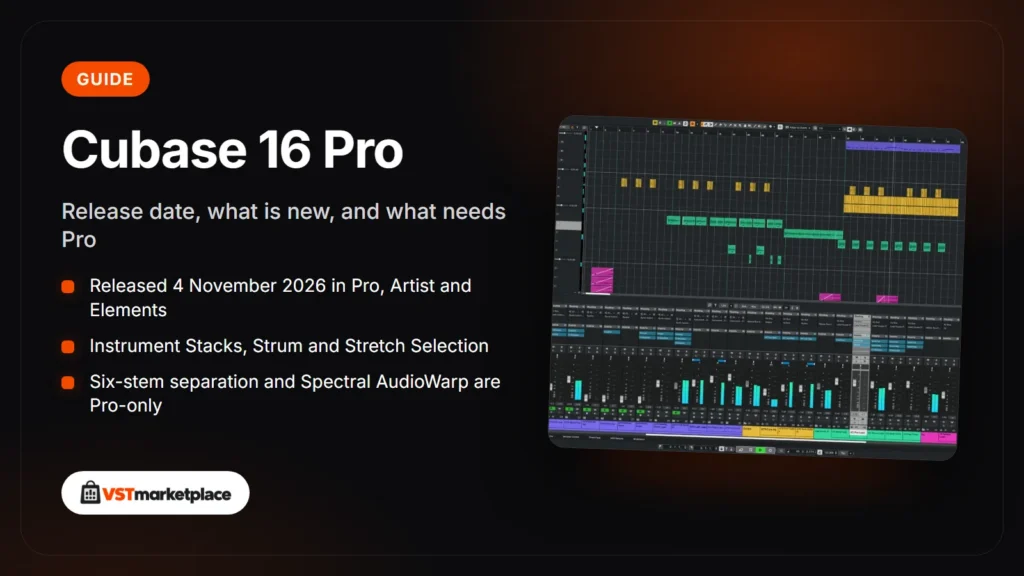
Short answer: The Cubase 16 release date is 4 November 2026, when Steinberg released Cubase 16, in three editions: Pro, Artist and Elements. The headline additions are Instrument Stacks, six-stem separation, Spectral AudioWarp, double the audio sends, and new MIDI editing tools such as Strum and Stretch Selection. Some of these are Pro-only, so check the table below before you choose an edition.
This guide covers the release date, what is new in Cubase 16 Pro, which features need Pro, and the operating systems Steinberg lists. It draws on Steinberg’s announcement coverage from MusicTech, Production Expert and Dubspot.
Cubase 16 release date and editions
Cubase 16 was released on 4 November 2026. It comes in three editions: Cubase Pro 16 is the top edition, Cubase Artist 16 is the mid-tier edition, and Cubase Elements 16 is the entry edition. Several of the new tools are limited to Pro, so the edition you pick decides what you get.
What’s new in Cubase 16 Pro
Steinberg’s announcement and coverage list these additions. The table shows which editions include each one, as the sources state.
| Feature | What it does | Editions |
|---|---|---|
| Six-stem separation | Splits a recording into vocals, drums, bass, piano, guitar and other stems. Dubspot describes the new piano and guitar stems. | Pro |
| Spectral AudioWarp | New time-stretch and pitch algorithms from Steinberg’s HALion team, built for extreme stretching and sound design. | Pro |
| Audio sends | 16 sends per channel, up from eight, and eight cue sends, up from four. | Pro |
| Instrument Stacks | Combines several VST instruments, Sampler Tracks and Drum Tracks into one playable instrument, with per-layer filtering. | Pro and Artist |
| DrumChain | A multi-effects processor designed for drums. | Pro and Artist |
| Module FM library | More than 200 HALion Sonic presets for leads, keys, basses and textures. | Pro and Artist |
| Strum | Adds natural timing variation to programmed chords in the Key Editor. | All editions |
| Stretch Selection | Stretches or compresses a MIDI passage, or adds an accelerando or ritardando. | All editions |
| Lyrics in the Key Editor | Type lyrics next to the notes, with pronunciation and language controls. | All editions |
| VocalTouch and Omnivocal Basic | VocalTouch gives polished vocal sounds with a few controls. Omnivocal Basic, built on Yamaha’s NX vocal synthesis engine, sketches vocal lines with two voicebanks. | All editions |
| Ableton Link and MIDI 2.0 | Syncs tempo and transport with compatible apps, and adds Note Expression and Expression Maps support. | All editions |
Other changes include a rebuilt Settings window, improved tempo detection, an extended ASIO-Guard buffer, Quick Help, and an integration with Waves Illugen.
Which Cubase 16 tools need Pro?
If you mainly work with recorded audio and MIDI songs, the tools most likely to matter are the ones Steinberg limits to Pro. Six-stem separation and Spectral AudioWarp are Pro features, as is the doubled number of sends per channel. Instrument Stacks, DrumChain and the Module FM library come with Pro and Artist, while Strum, Stretch Selection, Lyrics and Omnivocal Basic are in every edition. If you already use Cubase Artist, these gaps are the main reasons to look at Pro.
A closer look at the headline tools
Instrument Stacks is the change most likely to affect how you build sounds. You can stack several VST instruments, Sampler Tracks and Drum Tracks into one playable instrument, and Production Expert reports per-layer filtering and unified control over the stack. Layering a bass with a sampled drum hit or a synth pad with a piano is now one track rather than several.
Spectral AudioWarp is aimed at more than transparent tempo matching. According to Dubspot, the new modes can reshape vocals, instruments, drums and full mixes in ways the earlier algorithms could not. They suit sound design and extreme stretching, and they are in Pro only.
Strum and Stretch Selection are Key Editor tools that help with MIDI timing. Strum adds natural timing to programmed chords, from a subtle spread to a full strummed performance. Stretch fits melodies, basslines and chord progressions to a new length, and can add an accelerando or ritardando with one gesture. Both are in every edition.
Omnivocal Basic is a lightweight tool for sketching vocal ideas. Dubspot describes it as a lightweight tool for sketching vocal ideas. It is included in every edition, and VocalTouch, which gives vocal processing with a few controls, is also in every edition.
Cubase 16 system requirements
Steinberg’s requirements, as listed in Production Expert’s coverage, are these:
- Windows: 64-bit Windows 11 version 25H2 or higher, or 64-bit Windows 10 version 22H2 or higher. The CPU is an Intel Core i5 (8th generation) or later, an AMD Ryzen 3000 series, or a Windows on Arm processor.
- macOS: macOS 27 Golden Gate, macOS 26 Tahoe or macOS 15 Sequoia. The CPU is an Intel Core i5 (late 2018 or later) or Apple silicon.
The coverage did not give RAM or disk space figures. Check the Cubase Pro 16 listing for the figures we show there, and check Steinberg’s own pages before you buy.
Where to get Cubase Pro 16
We sell Steinberg Cubase Pro 16 for Windows and macOS. If your computer does not meet the Cubase 16 requirements, Steinberg Cubase Pro 15 is the previous version. You can find more digital audio workstations in our DAWs category, or compare them in our best DAW guide. Steinberg’s other products are listed on our Steinberg brand page.
Written by the VSTmarketplace team from the developers’ published information.
Frequently asked questions
When was Cubase 16 released?
Steinberg released Cubase 16 on 4 November 2026, in Pro, Artist and Elements editions.
What is new in Cubase 16 Pro?
The main additions are six-stem separation, Spectral AudioWarp, Instrument Stacks, 16 audio sends per channel, DrumChain, Strum, Stretch Selection, Lyrics in the Key Editor, Omnivocal Basic and Ableton Link support. Some of these are Pro-only.
Does Cubase 16 have six-stem separation?
Yes, in Cubase Pro 16. It separates a recording into vocals, drums, bass, piano, guitar and other stems, according to MusicTech and Production Expert. Dubspot describes the new piano and guitar stems.
Does Cubase 16 run on Windows on Arm?
Production Expert lists Windows on Arm processors among the supported CPUs for Cubase 16 on Windows.
What is the difference between Cubase Pro 16 and Artist 16?
Pro adds Spectral AudioWarp, six-stem separation, the doubled number of sends per channel and extra Pro-only tools. Instrument Stacks, DrumChain and the Module FM library are in both Pro and Artist.