There is no single best synth VST: the right one depends on the sound you want to make. For wavetable basses and leads, look at Xfer Records Serum 2, u-he Hive 2 or Arturia Pigments 7; for the sound of classic analogue hardware, u-he Diva and u-he Repro; for deep sound design, u-he Zebra 3 or Kilohearts Phase Plant; and for large ready-made libraries, Spectrasonics Omnisphere 3 or reFX Nexus 5. If you want to start without buying anything, the free tier of Vital is a good way to learn wavetable synthesis.
How this list was chosen
The synths are grouped by the type of synthesis they are built around, because that decides what they sound like and how you work with them. Within each group we picked the synths whose developers document their features, formats and requirements in full, and which are among the most searched-for names in the category. Every feature, format and requirement below comes from the developer’s own pages.
The list includes synths VSTmarketplace does not sell (Arturia Pigments 7, Kilohearts Phase Plant and Vital). The order inside each section is not a ranking, and no synth is placed higher because the store sells it.
Wavetable synths
Wavetable synths play a series of single-cycle waveforms and move through them over time. They are the usual choice for modern basses, leads and evolving pads.
Xfer Records Serum 2
Serum 2 is a hybrid synth built around a wavetable oscillator with smooth interpolation between frames and warp modes such as FM, phase distortion, ring modulation and distortion. Xfer Records added multisample, sample, granular and spectral oscillators, so one patch can mix wavetables with recordings of real instruments. It also has flexible effect routing, an arpeggiator and a clip sequencer, and comes with over 600 presets and close to 300 wavetables. Serum 2 runs as VST3, AU and AAX on Windows 10 or later and macOS (macOS 11 or later on Apple Silicon).
u-he Hive 2
Hive 2 is u-he’s streamlined synth, designed for low CPU use. It has three synth engines and two oscillators that play standard waveforms or 2D wavetables with up to 16x unison, plus drag-and-drop modulation, an arpeggiator and step sequencer, and seven rearrangeable effects. u-he lists over 2,400 factory presets. Like all u-he synths it is a plugin only (VST3, AU, AAX and CLAP) and runs on Windows 7 or newer and Mac OS X 10.10 or newer.
Arturia Pigments 7 (not sold here)
Pigments goes beyond wavetables: Arturia lists six forms of synthesis (wavetable, virtual analogue, sample, harmonic, granular and modal) and over 1,700 factory presets, with a free Pigments Play version that has 100 presets. It runs standalone or as VST, AU and AAX on Windows 10 or later (64-bit, no ARM) and macOS 11 or later.
Vital (not sold here)
Vital is a spectral warping wavetable synth: its warp modes act on a waveform’s harmonics. You can turn your own samples into wavetables, draw them in the built-in editor or generate them from text. The free Basic tier includes 75 presets and 25 wavetables; paid tiers add more. It runs on Windows 10, macOS 10.15 (Intel or Apple Silicon) and Ubuntu 18.04 or newer. The developer’s main page does not list plugin formats.
Analogue-modelling synths
These synths model the circuits of classic hardware. They are the ones to look at if you want the character of vintage polysynths and monosynths.
u-he Diva
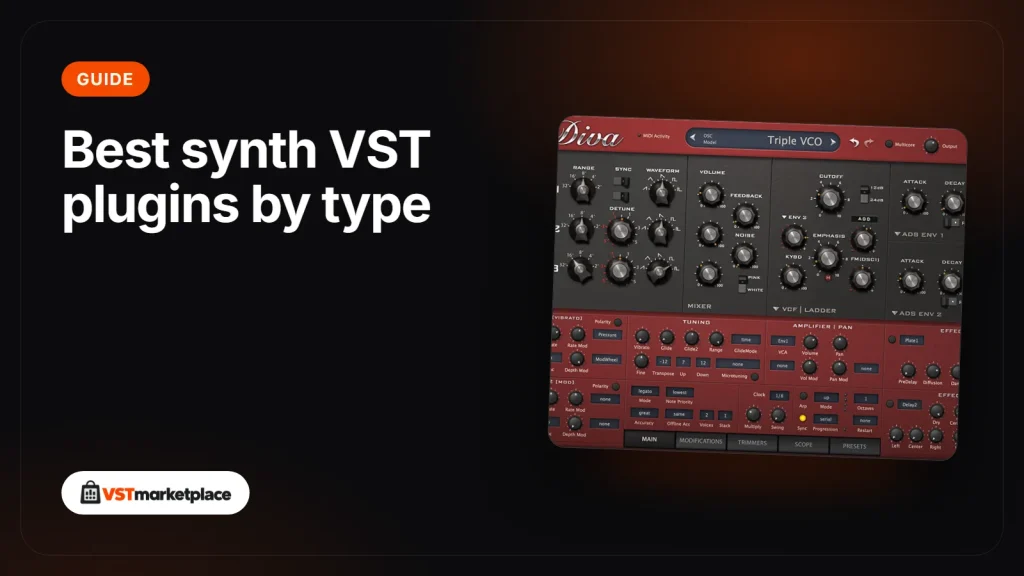
Diva models the oscillators, filters and envelopes of classic monophonic and polyphonic hardware. You can mix five oscillator models (Triple VCO, Dual VCO, DCO, Dual VCO Eco and Digital) with five filter models (Ladder, Cascade, Multimode, Bite and Uhbie), all built with zero-delay-feedback filters and real-time circuit simulation. It plays up to 16 voices, supports MPE and has over 1,200 factory presets. u-he says Diva takes quite a high CPU hit, so it has an adjustable quality setting with a separate setting for offline bounces.
u-he Repro
Repro is two synths in one: the monophonic Repro-1 and the polyphonic Repro-5, both modelled at component level on classic analogue instruments. Repro-1 has two oscillators, a four-pole resonant lowpass filter and a twin 32-step sequencer. Built-in effects include an analogue-style delay and chorus, plate reverb and a wave folder, and a Sleepy mode saves CPU while the synth is idle. u-he lists over 500 factory presets.
Modular synths for sound design
u-he Zebra 3
Zebra 3 is u-he’s modular synth, rebuilt from the ground up with virtual analogue, physical modelling and digital synthesis. Modules only appear once you add them, which keeps large patches readable. Oscillators run as wavetable (up to 16x unison) or additive (more than 1,000 partials), filters come in 13 models with over 100 responses, and modal resonators and comb filters cover physical modelling. It supports MPE, microtuning and MTS-ESP and has over 1,200 presets. Zebra 3 replaces Zebra2, which u-he still sells as Zebra Legacy. It needs Windows 7 or macOS 10.13 or newer and a display of at least 1300 x 910 pixels.
Kilohearts Phase Plant (not sold here)
Phase Plant is a semi-modular synth: you combine generators (standard waveforms, wavetables, samples and noise), modulators and effects in any order. Effects load as Snapins in three effect lanes, and Kilohearts Essentials is included. Kilohearts lists VST2, VST3, AU and AAX hosts on Windows and macOS, including Apple M processors.
Sample-based and preset-led synths
Spectrasonics Omnisphere 3
Omnisphere 3 combines DSP synthesis with sample-based sound sources and a library of over 41,000 sounds. A patch can use up to 20 oscillators, with granular synthesis, wavetables, FM and the new Quadzone synthesis, 69 filter algorithms, 93 effects and full MPE support. It also offers hardware integration for over 300 hardware synth models. Omnisphere 3 replaces Omnisphere 2, and Spectrasonics says the new library takes no more drive space. It needs around 65 GB of free disk space, 8 GB of RAM (16 GB recommended) and Windows 10 or macOS 13 Ventura, and runs standalone or as VST3, VST2, AU or AAX.
reFX Nexus 5
Nexus 5 is a preset-based synth: you mostly browse and play finished sounds rather than build them from scratch. It still has eight generators (virtual analogue, sampler, wavetable, time stretcher, retro sampler, grain, cloud and FM), effects, an arpeggiator and a trancegate. The standard content is over 5,400 presets and about 47 GB of samples; with all expansions it grows to over 34,000 presets and more than 300 GB. reFX names FL Studio, Ableton Live, Logic Pro, Cubase, Pro Tools, Bitwig Studio and REAPER as compatible hosts.
Formats and systems at a glance
| Synth | Type | Formats | Windows | macOS |
|---|---|---|---|---|
| Xfer Records Serum 2 | Wavetable (hybrid) | VST3, AU, AAX | 10 or later | 10.13 (Intel), 11 (Apple Silicon) |
| u-he Hive 2 | Wavetable, low CPU | VST3, AU, AAX, CLAP | 7 or newer | 10.10 or newer |
| Arturia Pigments 7 | Six synthesis types | Standalone, VST, AU, AAX | 10 or later | 11 or later |
| Vital | Wavetable | Not listed | 10 or later | 10.15 or later |
| u-he Diva | Analogue modelling | VST3, AU, AAX, CLAP | 7 or newer | 10.10 or newer |
| u-he Repro | Analogue modelling | VST3, AU, AAX, CLAP | 7 or newer | 10.10 or newer |
| u-he Zebra 3 | Modular | VST3, AU, AAX, CLAP | 7 or newer | 10.13 or newer |
| Kilohearts Phase Plant | Semi-modular | VST2, VST3, AU, AAX | Not stated | Not stated |
| Spectrasonics Omnisphere 3 | Samples and DSP | Standalone, VST3, VST2, AU, AAX | 10 or higher | 13 Ventura or higher |
| reFX Nexus 5 | Preset-based | VST2, VST3, AU, AAX | 10 or 11 | 10.13 or later |
How to choose
- Sound first. Wavetable synths suit modern basses and leads, analogue models suit vintage pads and monosynth lines, modular synths suit experimental sound design, and preset-led synths suit producers who want finished sounds quickly.
- CPU. u-he designed Hive 2 for low CPU use, while it says Diva has a high CPU cost. Repro’s Sleepy mode saves CPU when idle.
- Disk space. The u-he synths need a few hundred MB each. Omnisphere 3 needs around 65 GB, and Nexus 5 with all expansions needs more than 300 GB.
- Format and DAW. Logic Pro loads AU and Pro Tools loads AAX; most other DAWs load VST3. The u-he synths also come as CLAP.
- Current version. Omnisphere 3 replaces Omnisphere 2, and Zebra 3 replaces Zebra2.
Getting several u-he synths at once
If more than one u-he synth appeals, the u-he Everything Bundle includes all seven of u-he’s synths (ACE, Bazille, Diva, Hive 2, Repro, Zebra 3 and Zebra Legacy) plus seven effects, 14 plug-ins in total, each delivered as its own product.
Where to find them
The synths we sell each have their own page with full requirements: Xfer Records Serum 2, u-he Hive 2, u-he Diva, u-he Repro, u-he Zebra 3, Spectrasonics Omnisphere 3 and reFX Nexus 5. To compare more instruments, browse all synth plugins.
Written by the VSTmarketplace team from the developers’ published information.
Frequently asked questions
What is the best synth VST for beginners?
u-he Hive 2 is a good first paid synth: u-he designed it to be streamlined and light on CPU, and it has over 2,400 presets to learn from. If you would rather play finished sounds, reFX Nexus 5 is preset-based, and the free tier of Vital lets you learn wavetable synthesis before you buy.
What is the best wavetable synth?
Xfer Records Serum 2 combines a wavetable oscillator with multisample, sample, granular and spectral oscillators, so it offers the widest choice of oscillator types among the wavetable synths here. Arturia Pigments 7 adds five other forms of synthesis, u-he Hive 2 is the lighter option on CPU, and Vital has a free tier.
Which synth VST sounds most like analogue hardware?
u-he Diva and u-he Repro are the two synths in this list built specifically to model classic analogue circuits: Diva with real-time circuit simulation of oscillators, filters and envelopes, Repro with component-level models of a classic monosynth and polysynth.
Serum 2 or Omnisphere 3: which should I get?
Choose Serum 2 if you want to design your own sounds around wavetables and other oscillator types. Choose Omnisphere 3 if you want a large ready-made library: over 41,000 sounds, which needs around 65 GB of free disk space.
Do synth VSTs work in every DAW?
Only if your DAW supports one of the synth's formats. Most synths here come as VST3, AU on macOS and AAX; Logic Pro needs AU and Pro Tools needs AAX. The u-he synths need a host DAW, while Omnisphere 3 and Pigments 7 also run standalone.